


Price drivers
Capacity, span, lifting height, duty class, control mode, power supply and site conditions.

The LD single girder overhead crane features a compact structure and high overall rigidity. Its main beam adopts an I-beam box-type design and is used with CD or MD type electric hoists, making it a light-duty lifting device suitable for various applications.
Our Single Girder Overhead Crane is a compact and efficient lifting solution designed for workshops, warehouses, and production facilities. Engineered for precision and performance, it offers excellent load handling while minimizing headroom and space requirements.
This type of overhead travelling crane is widely used in:
Whether for indoor or outdoor operations, our single beam overhead cranes provide reliable support for daily material handling.
The commercial checks behind a crane quotation.
Swipe to compare capacities
| Specification | Unit | 1 t | 2 t | 3 t | 5 t | 10 t | 16 t | 20 t |
|---|---|---|---|---|---|---|---|---|
| Capacity | t | 1 | 2 | 3 | 5 | 10 | 16 | 20 |
| Span | m | 7.5–28.5 | ||||||
| Lifting height | m | 6–18 | ||||||
| Lifting speed | m/min | 0.8/8 | 0.8/8 | 0.8/8 | 0.8/8 | 0.7/7 | 0.6/6 | 0.42/4.2 |
| Trolley speed | m/min | 20 | ||||||
| Crane speed | m/min | 20 | ||||||
| Work duty | A3–A4 | A3–A4 | A3–A4 | A3–A4 | A3–A4 | A3–A4 | A3–A4 | |
| Track type | P24 | P24 | P24 | P24 | P24 / P38 | P24 / P38 | P24 / P38 | |
Values are for the standard LD range. Custom capacities, spans and lifting heights are quoted on request.
Standard values below. Final capacity, span and lifting height are confirmed on the approval drawing.
CD1 or MD1 wire rope hoist, with single- or dual-speed options.
Pendant, wireless remote or cabin control, matched to the working pattern.
Cable festoon, conductor bar or energy chain, selected for the runway layout.
Indoor or outdoor use, with anti-corrosion coating for outdoor installations.
LD, LDC and LDP share the same crane family. The difference is the hoist position and how much headroom the building has.


Single girder: 1–20 t, A3–A4, 7.5–28.5 m span. Double girder: 3–550 t, A3–A7, up to 31.5 m span and more hook room.
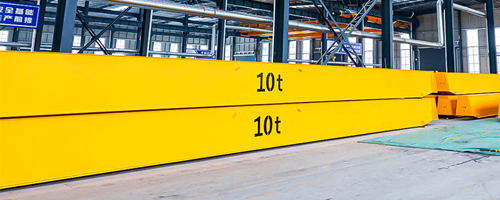
The main beam is the primary load-bearing component of the LD Type Single-Girder Overhead Crane, designed to support the electric hoist and transmit loads to the end beams and crane runway. It typically adopts a welded I-beam or box-girder structure. The design provides it maximum strength while keeping it as light as possible.
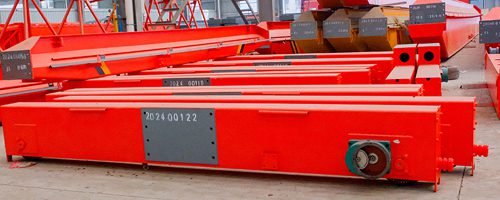
The end carriage (also known as end beam) is responsible for supporting the main beam and enabling the crane to move along the runway rails. It houses the crane travel mechanism, which includes motors, gear reducers, driving wheels, and idler wheels. The driving wheels are powered by motors to move the entire crane along the tracks, while the idler wheels provide balance and support.

The wire rope electric hoist consists of the trolley running mechanism, hoisting mechanism, and electrical system.
The trolley running mechanism includes the motor, gearbox, trolley wheels, and electrical components. It is mounted under the main beam of the bridge crane and moves left and right along the main beam, with a standard speed of 20m/min.
The hoisting mechanism includes the motor, gearbox, drum and housing, wire rope, hook, and electrical components. It is installed under the trolley to perform upward and downward movements. The hoist is available in both single-speed and dual-speed versions.

The electrical control system consists of the main trolley control box (DK box), electric hoist control box (CD/MD box), overload limiter, fire-cut limit switch, travel switches, remote control, collector, seamless sliding conductor rail, cable wheel, drag cable, wire guide, rope clamp, flanged bolts, and other accessories.
Determine the maximum lifting weight and the type of materials to be handled, then choose a suitable crane model.
Measure the building’s span, height, and other clearance data to ensure compatibility.
Options include wired pendant control or wireless remote control, ground control or cabin control, depending on user preference.
For high-temperature, dusty, or humid environments, select components with heat resistance, dust protection, and moisture resistance. For outdoor use, a rain cover is recommended.

In late 2025, a heavy machining and assembly company started a factory expansion. This company is in Monterrey, Mexico. They mainly process auto...
View project
In international procurement of large engineering equipment, bulk delivery capacity measures a heavy enterprise's comprehensive strength. Recently...
View projectOverhead, gantry, jib and special cranes designed to your drawings, duty cycle and site conditions.
Learn more 02Built in our own facilities with traceable steel, certified welding and full inspection.
Learn more 03Field teams supervise or complete installation, alignment, load testing and commissioning worldwide.
Learn more 04On-site or remote training covering safe operation, inspection routines and preventive maintenance.
Learn moreShort answers to the questions that come up before this model is specified.
Ask an engineerThe standard LD range covers 1–20 t capacity, 7.5–28.5 m span, 6–18 m lifting height and A3–A4 work duty. Larger capacities, spans and lifting heights are quoted on request.
LD is the standard single girder crane with the hoist under the main beam. LDC is the low-headroom version with the hoist running on the bottom flange. LDP is the side-mounted version with a raised trolley for low-clearance buildings.
Yes, provided the span, headroom and runway/column capacity suit the crane. Send the building drawing and available headroom so our engineers can confirm the runway and clearance.
The scope normally includes the main girder, end carriages, hoist, travel mechanisms, electrical control and documentation. The exact scope is confirmed in the quotation.
Price depends on capacity, span, lifting height, duty class, control mode, power supply and site conditions. Send those values and we will confirm a firm specification and price.
Send the rated load, span, lifting height, available headroom, building or column drawing, power supply, control preference and the working environment.
Standard LD configurations are typically 20 working days; the final schedule is confirmed with the quotation. Warranty is 24 months from the date of shipment.
Tell us the capacity, span and lift height for the Single Girder Overhead Crane. Send drawings if you have them — our engineers will confirm the configuration and price.
Send capacity, span and lift height; we confirm the configuration.


